Not sure what your trees need? Our certified arborists can help.
Every storm season in Middle Tennessee, trees come down that looked healthy just days before. To homeowners, it often feels like the tree failed without warning. However, storms rarely create the problem, they just expose weaknesses that had been developing for years.
Hidden decay, root damage, and weak branch attachments don’t always show obvious symptoms, but they can significantly reduce a tree’s ability to withstand high winds. Understanding why trees fail starts with looking beyond the leaves and focusing on the tree’s structural health.
Key Takeaways
- Most trees that fail in storms already have structural defects, such as internal decay, compromised root systems, co-dominant stems, or included bark, long before severe weather arrives.
- Summer storms are especially damaging because fully leafed canopies catch more wind, and heavy rain can saturate Nashville’s clay soils before the strongest gusts arrive.
- Many structural defects are hidden, but warning signs like dead branches, trunk fungi, widening cracks at branch unions, and a tree that has recently begun leaning deserve a professional evaluation.
- Structural pruning can reduce the likelihood of storm damage by improving a tree’s structure, while improper practices like topping and lion’s-tailing make trees more likely to fail.

Two of the most common outcomes of storm tree failure in residential yards: a limb failure at a weak branch union (left) and a full uprooting at the root system (right).
Why Do Trees Fall in Storms Even When They Look Healthy?
Most trees that fail in storms don’t snap because they were healthy and the wind was simply too strong. They fail because they already had structural defects that reduced their ability to withstand heavy wind loads. Many of those defects develop slowly over years and remain hidden beneath the bark or below the soil, making them difficult for homeowners to recognize.
The most common causes of storm failure include internal decay, compromised root systems, co-dominant stems, and included bark.
Internal Decay
Internal decay hollows out wood from the inside while the bark surface looks completely normal. A tree can lose significant structural integrity long before any outward sign appears — no discoloration, no dieback, no visible damage. By the time decay is obvious, the failure risk is already well established.
Compromised Root Systems
A tree’s root system can be weakened by construction activity, compacted soil, or circling (girdling) roots — leaving far less anchoring strength than the canopy suggests. Because roots are underground, this defect is almost never visible until a tree uproots. Trees recently exposed by nearby land clearing are especially vulnerable, since their root systems developed under sheltered conditions and haven’t adapted to bearing full wind load.
Co-Dominant Stems
Co-dominant stems develop when two trunks or large branches of nearly equal size grow from the same point on the tree. Instead of one dominant trunk supporting smaller branches, both stems compete for space as they increase in diameter. That growth pattern often creates one of the most common structural defects arborists find during tree risk assessments.
PRO TIP: If you have Bradford pears in your neighborhood, you almost certainly have co-dominant stems. The tight V-shaped branch structure that defines that tree means virtually every Bradford pear carries included bark throughout. They’re quite common in established East Nashville neighborhoods, and given enough time — and enough wind — they’re a near-certain failure waiting for the right conditions.
Included Bark
Included bark forms when bark becomes trapped between two co-dominant stems instead of the stems developing strong, interlocking wood. Rather than bonding together as the tree grows, the bark acts like a wedge that gradually pushes the stems apart. The union may appear solid from the outside, but it requires far less force to split during high winds than a properly formed branch attachment.
Why Summer Is the Worst Time for a Storm to Hit Your Trees
Summer stacks the odds against your trees in ways no other season does:
The Windsail Effect Makes Summer Canopies Vulnerable
A leafed-out canopy doesn’t let wind pass through — it stops it. Every leaf and branch acts like a surface that catches wind rather than deflecting it, turning the crown into a sail and transferring that load to the trunk, major branches, and root system.
Saturated Soil Undermines the Root System
Nashville’s clay-heavy soils hold water after heavy rain, which reduces the friction that keeps roots anchored in place. A tree that stands firm in dry soil can uproot when that same soil is waterlogged. And summer thunderstorms tend to drop heavy rain before the strongest gusts arrive — which means the ground is already saturated at exactly the wrong moment.
Isolated Trees Bear the Full Brunt of Wind Exposure
A tree surrounded by other trees shares wind load and has a root system conditioned to partial shelter. A yard tree — isolated from neighboring properties by structures and fencing — bears the full wind load with nothing to buffer it or help the roots stay anchored in place.

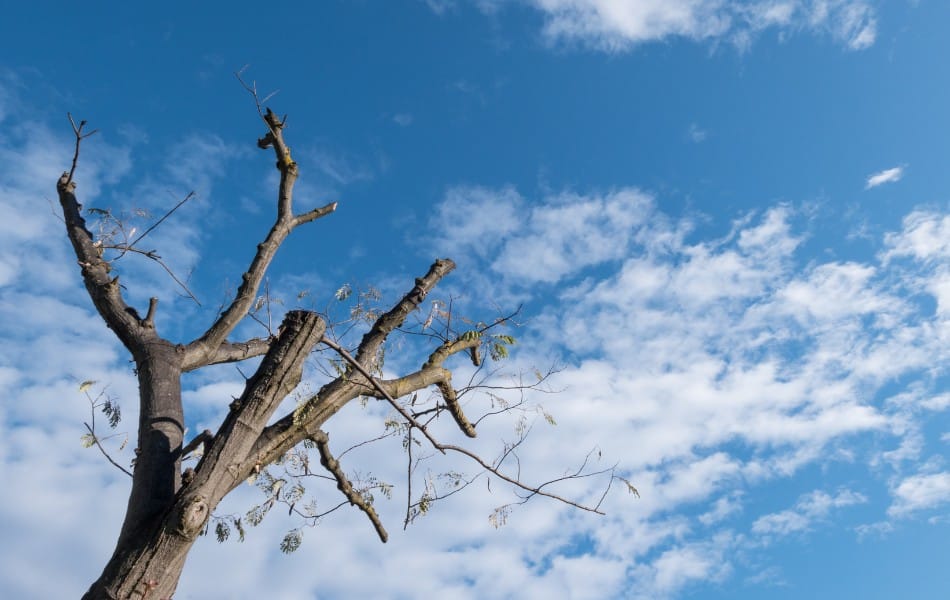
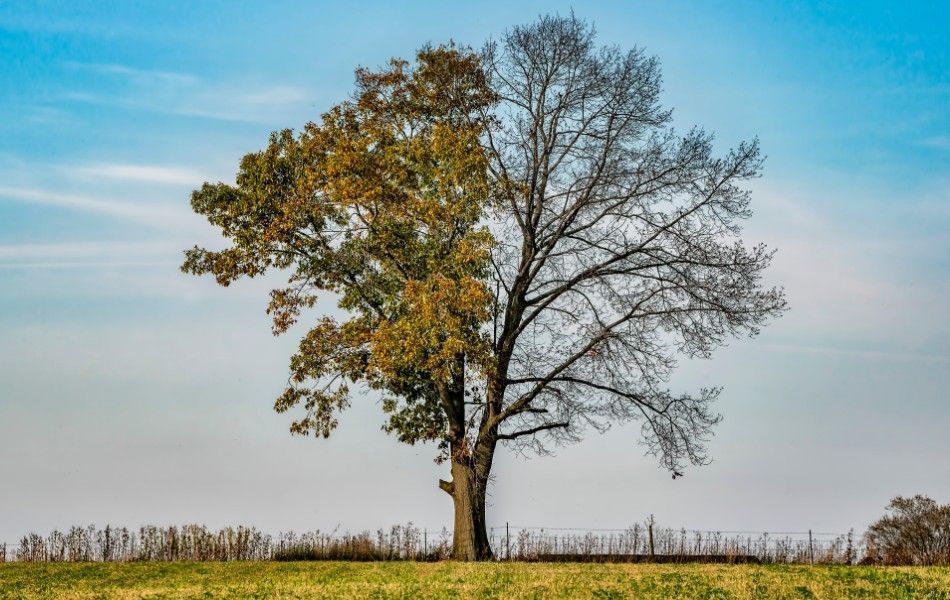
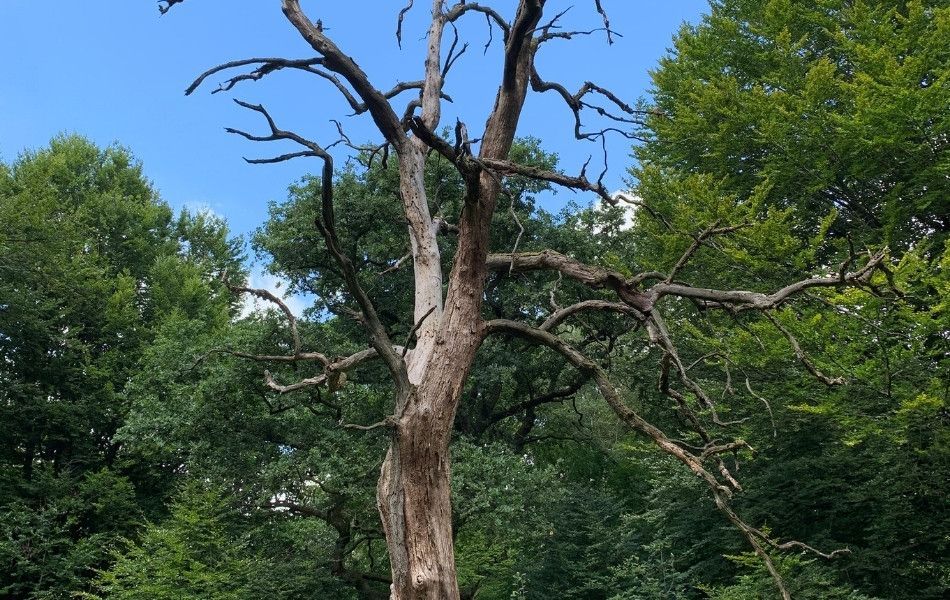
Three visible warning signs of storm risk: bark cracking at a union (left), dead branches concentrated in the upper canopy (center), and a tree with a noticeable lean (right).
What Are the Warning Signs That a Tree Is a Storm Risk?
While many structural defects are hidden, some produce visible warning signs that homeowners can spot before a storm. Watch for:
- Visible Cracks or Gaps at a Stem Union: A crack where two stems meet can be an early sign that the union is beginning to separate. In some trees, it appears as a thin dark line; in others, the gap is wide enough to see daylight through.
- Dead Branches in the Upper Canopy: These are the highest-probability failure points in any storm because dead wood doesn’t flex — it breaks.
- Long, Heavy Limbs with Minimal Taper: Limbs that extend well beyond the canopy edge concentrate weight far from the trunk, increasing the lever effect on the union under wind load.
- Shelf Fungi or Conks on the Base of the Trunk: These indicate internal decay is already active. By the time they appear, structural integrity is often already compromised.
- Trees Recently Exposed by Construction or Land Clearing: Root systems that developed under sheltered conditions haven’t adapted to bearing full wind load. Sudden exposure significantly raises failure risk.
- Circling Roots at the Trunk Base: Roots that wrap around the base of the trunk instead of growing outward can restrict root development and reduce a tree’s long-term stability.
- A Lean That Has Noticeably Increased: A tree that suddenly begins leaning more than it did before may have a compromised root system or shifting soil and should be evaluated promptly.
How Can I Reduce the Chances of Tree Failure During a Storm?
The best way to reduce storm risk is to schedule structural pruning. Proper pruning reduces the wind load your trees have to resist — without affecting their health or appearance.
What Professional Pruning Actually Does
Done correctly, structural pruning addresses storm risk in three ways:
- Crown Thinning: Removes selected interior branches so wind passes through the canopy rather than pushing against it as a solid mass.
- End Weight Reduction (Reduction Cuts): Shortens overextended limbs back to a properly sized lateral, removing the lever effect that causes limb failure under load.
- Early Structural Training on Young Trees: Establishes a single dominant leader and prevents co-dominant stems from forming — far less costly than correcting them on a mature tree later.
Establishing a single dominant leader early prevents co-dominant stems from forming altogether — the most reliable outcome. For trees that already have co-dominant stems but don’t need removal, cabling and bracing can provide supplemental support and reduce the risk of splitting at the union.
Poor Pruning Practices Increase Storm Risk
Not all pruning reduces risk — two common practices actually increase structural problems rather than resolve them:
- Topping: The practice of cutting branches back to stubs triggers fast-growing but weakly attached regrowth that’s more hazardous than what it replaced.
- Lion’s-Tailing: Named for the way it leaves a bare limb with a tuft of foliage at the end (like a lion’s tail), this practice strips interior branches and concentrates all the weight at the tips — maximizing the lever effect on every limb when wind load hits.
Frequently Asked Questions About Why Trees Fail in Nashville Storms
How do I know if my tree has internal decay?
Look for shelf fungi or conks at the base of the trunk, soft or sunken bark, and hollow sounds when the trunk is knocked — but none of these are definitive on their own. A Certified Arborist can use tools like a resistograph or sonic tomography to assess internal condition without damaging the tree.
At what age or size do trees become a serious storm risk?
Size matters less than species and structure, but larger trees cause more damage when they fail — which makes assessment more urgent the bigger and older a tree gets. However, fast-growing species, like silver maple and Bradford pear, can develop serious structural problems much earlier than slower-growing hardwoods.
Should I remove a tree with co-dominant stems, or can it be saved?
Not necessarily — it depends on the tree’s size, species, location, and how developed the included bark is. Cabling and bracing can reduce failure risk on trees that don’t need removal, while corrective pruning can sometimes redirect growth on younger trees. A Certified Arborist can assess which option makes the most sense for your situation.
How often should trees be professionally assessed for storm risk?
Trees should be professionally assessed for storm risk every 3-5 years — or more frequently if trees are near structures or have known defects. An assessment after any significant storm event is also worth scheduling, since damage isn’t always visible from the ground.
Does homeowners insurance cover storm damage from trees?
In many cases, homeowners insurance covers damage to your home or other insured structures caused by a fallen tree. However, policies often don’t cover the cost of removing the tree unless it’s blocking access to your home or driveway or has damaged a covered structure. If you’re unsure what’s covered, review your policy or contact your insurance provider.
Keeping records of professional tree inspections can also be helpful if questions arise about the tree’s condition during the claims process.

A professional arborist assessment can identify structural defects, such as internal decay, weak branch unions, root problems that aren’t visible from the ground.
Is Your Tree Ready for Nashville’s Next Storm?
Most storm-related tree failures don’t happen without warning. Hidden decay, weakened roots, poor branch attachments, and other structural defects often develop over many years before high winds expose them. Identifying those problems early gives you more options to reduce the risk before they become an emergency.
If you’re not sure whether your trees are ready for what Nashville’s summer storm season brings, we’re happy to take a look. Call us at 615-239-9223 or request an estimate — let’s see what you’re working with before the next forecast rolls in.
Brian Holloway
Brian Holloway is the founder and owner of Tree Solutions, a family-owned tree care company serving Middle Tennessee. With nearly 20 years of experience, he has overseen thousands of residential and commercial tree care projects and is dedicated to providing professional, dependable service.