Not sure what your trees need? Our certified arborists can help.
The Tennessee Department of Agriculture has confirmed EAB in more than 65 Tennessee counties, including Davidson County, and the insect continues to spread across the state. That means ash trees throughout the Nashville area remain at risk.
The good news is that an emerald ash borer infestation doesn’t automatically mean your tree has to be removed. Many ash trees can still be preserved with timely treatment. Whether treatment or removal makes more sense depends on the tree’s condition and how far the infestation has progressed.
Key Takeaways
- Emerald ash borer is established across Middle Tennessee and kills untreated ash trees within 2-4 years of infestation.
- D-shaped exit holes, a thinning canopy from the top down, bark splits, and increased woodpecker activity are the most reliable warning signs to watch for.
- Trunk injection can protect a healthy ash tree, but only if treatment begins before canopy loss gets too advanced, which is generally below the 50 percent mark, and sooner is always better.
- Once an ash tree is in advanced decline or dead, removal is the safer call; EAB-killed ash becomes dangerously brittle and can fail without warning.
What Is Emerald Ash Borer?
Emerald ash borer is a small metallic-green beetle from Asia, and the adults you might spot are only about half an inch long — easy to miss entirely. The real damage happens out of sight, where the larvae tunnel beneath the bark and cut off the tree’s ability to move water and nutrients. By the time symptoms show on the outside, the infestation is usually well established.
That puts every native ash in Middle Tennessee at risk, including the white, green, and blue cultivars. And these trees have been exposed for a while: EAB was confirmed in Tennessee in 2010 and reached Davidson County in 2014. Once larvae become established, an untreated ash tree typically dies within 2-4 years. Because early infestations often produce few visible symptoms, waiting until a tree appears unhealthy can significantly reduce the chances that treatment will be successful.

How an emerald ash borer infestation reveals itself: canopy dieback that starts at the top (left), bark splitting and flaking as larvae tunnel underneath (center), and the telltale S-shaped galleries they leave in the wood (right) — feeding damage that cuts off the tree’s ability to move water and nutrients.
How Do You Know If Your Ash Tree Has Emerald Ash Borer?
You can confirm emerald ash borer by checking the tree for a specific set of physical signs. The earliest are subtle, and by the time the obvious ones show, the tree is often already in advanced decline. Here are the six most crucial to keep an eye out for:
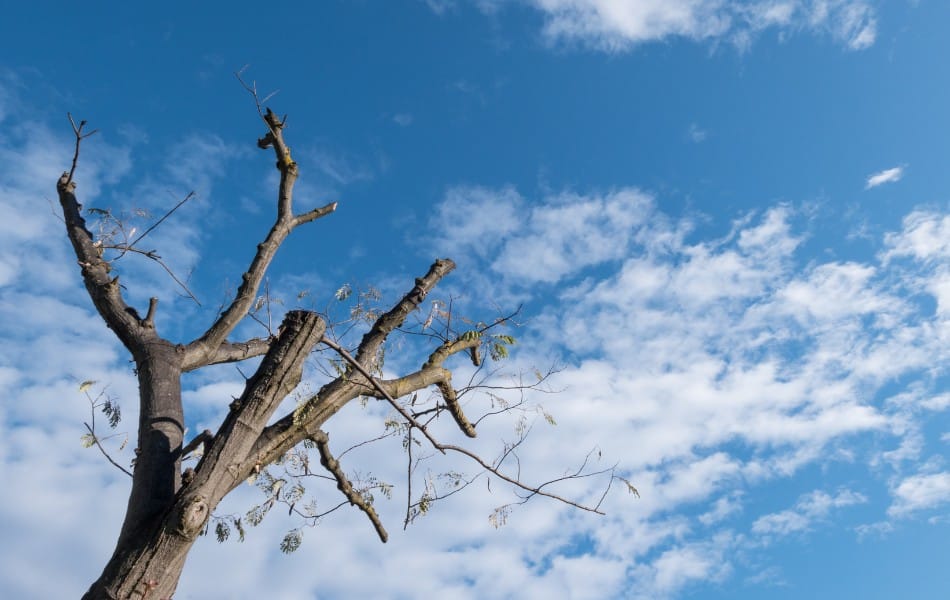
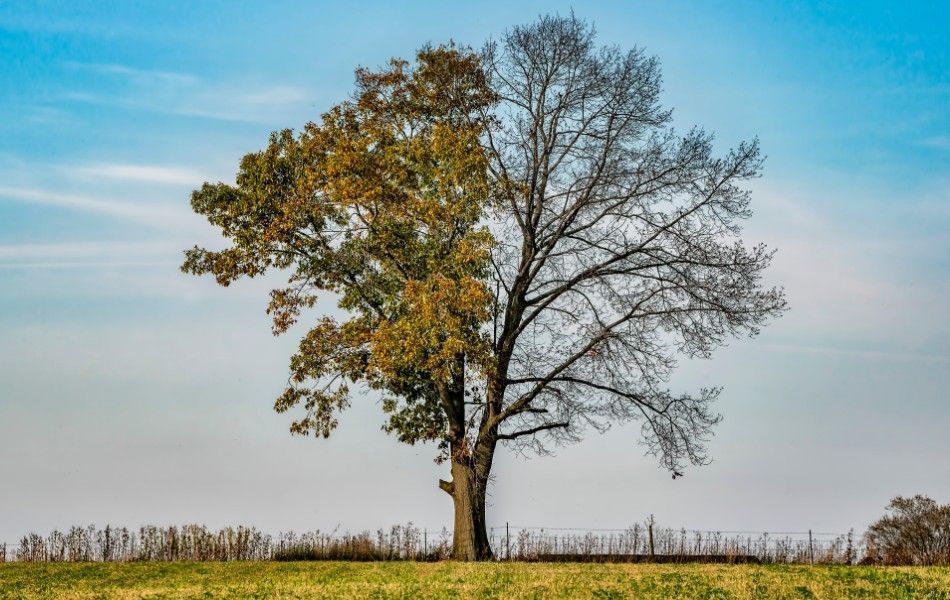
- Canopy Thinning from the Top Down: Dead branches and sparse foliage starting in the upper crown, since EAB damage works its way downward.
- D-Shaped Exit Holes: Openings about an eighth of an inch wide in the bark; if the holes are round, they’re likely from a different insect.
- S-Shaped Tunnels Under the Bark: Winding galleries that show up where a section of outer bark has flaked away.
- Bark Splits: Vertical cracks that expose the larval tunnels underneath.
- Woodpecker Activity and “Blonding”: Heavy pecking and pale patches where birds have stripped the outer bark to forage for larvae.
- Epicormic Shoots: Clusters of new sprouts low on the trunk or along major limbs, which are a stress response the tree puts out when it’s in decline.
Seeing two or more of these signs together on an ash tree is reason for a professional assessment from a Certified Arborist. EAB can look similar to storm damage, drought stress, or fungal disease from the outside, and confirming the actual cause (and whether treatment is still realistic) requires an in-person evaluation.
When Is It Too Late to Treat an Ash Tree for EAB?
An ash tree is often still worth treating if it has only moderate canopy loss and is not creating an immediate safety risk. Once decline becomes severe, removal is usually the safer option.
The best candidate of all, however, is a healthy ash with no symptoms. If EAB has turned up near you, treating a still-healthy tree preventively gives it the strongest odds: you’re protecting it before larvae ever establish, rather than trying to rescue it after the damage starts.
If your tree is already showing symptoms, treatment may still be possible — but whether it’s the right call comes down to a few things an arborist weighs in person:
- Canopy Condition: Treatment is significantly more effective when canopy loss is below 50 percent; past that point, a tree typically can’t be adequately treated.
- Location and Risk: Even a treatable tree may be better off removed if it sits close to the house, driveway, or any structure a future failure could damage.
- Treatment Investment: Treatment is an ongoing investment, so it’s worth considering what the tree contributes to your property. Large, mature ash trees that provide shade, privacy, or significant landscape value are often good candidates because preserving them typically costs less than removing and replacing them. For smaller trees or those with limited landscape value, removal and replacement may be the more practical long-term choice.

Trunk injection is the standard way to protect a viable ash tree from emerald ash borer. A licensed applicator delivers an EAB-targeted insecticide directly into the trunk, and the tree distributes it up through the canopy; the treatment continues on a regular cycle for the life of the tree.
How Do You Treat Emerald Ash Borer?
When treatment is appropriate, an EAB-targeted insecticide is injected directly into the trunk, where it’s carried throughout the tree to target feeding larvae beneath the bark. To remain effective, treatments must be repeated on a regular schedule for as long as you want to protect the tree.
PRO TIP: The best window for trunk injections in Middle Tennessee is spring through early summer, but treatment should begin as soon as EAB is confirmed in a tree or nearby ash.
What Happens If an Ash Tree Can’t Be Treated for Emerald Ash Borer?
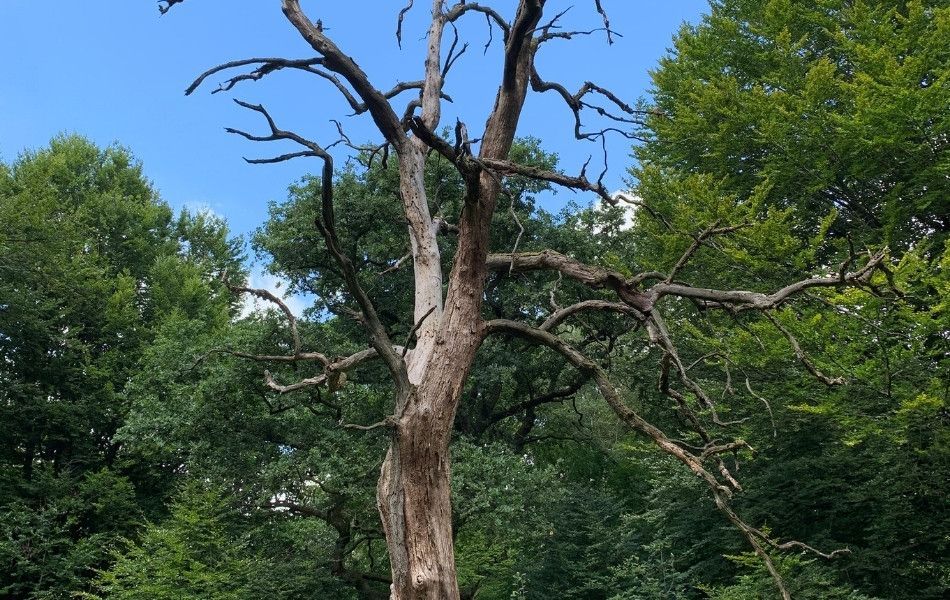
Once an ash tree has declined beyond the point where treatment is likely to succeed, removal usually becomes the safest option. Waiting rarely improves the outcome. As emerald ash borer kills the tree, the wood becomes increasingly brittle, making branch failure more likely and removal more difficult over time.
Why You Shouldn’t Wait to Remove a Dead Ash Tree
The longer a dead ash tree stands, the fewer safe and cost-effective removal options remain. Many tree services won’t climb an ash that has been dead more than roughly six months because the wood can’t be trusted to hold a climber’s weight. At that stage, removal requires a self-propelled lift on turf-friendly tires, a crane-mounted grapple saw, or both. The equipment exists, but the window to handle the job safely narrows fast.
If your ash tree is past the point of treatment, planning removal during a calm season is typically safer and gives you more scheduling flexibility than waiting until the tree becomes an emergency.
Frequently Asked Questions About Emerald Ash Borer in Nashville
Do I need a permit to remove an ash tree on my Nashville property?
In most of Metro Nashville, no permit is required to remove a tree on private residential property. Exceptions include Forest Hills (which has its own permit requirement), commercial properties, and trees located in the public right-of-way along streets and sidewalks. When in doubt, a Tree Solutions arborist can confirm whether your specific property falls under any of those exceptions.
Can I keep the wood from a removed ash tree for firewood?
You can, but only if you keep it on your property or burn it locally (or, within roughly 50 miles of where it was cut). Federal and state quarantine guidance discourages moving untreated ash firewood longer distances because EAB larvae can survive in unprocessed wood and spread to new areas. If you’d rather not deal with curing and splitting it yourself, our team can dispose of it properly for you.
How can I tell if a tree on my property is actually an ash?
Ash trees have compound leaves with five to nine leaflets arranged opposite each other along the stem, diamond-pattern ridges in mature bark, and flat paddle-shaped seed clusters in fall. Opposite branching (where twigs and buds grow directly across from each other) is the easiest single feature to check. If you’re not sure, a Certified Arborist can confirm the species and assess the tree for EAB during the same visit.
Can my neighbor’s untreated ash trees infect mine?
Yes; adult EAB beetles can fly between trees, and an untreated infested tree nearby acts as a continuous source of new beetles. Treating your own ash protects that specific tree even when neighborhood pressure is high, but it doesn’t eliminate the broader risk. This is one reason early action matters: catching the infestation while population pressure is still building gives the treatment its best chance of working.
What should I plant to replace a lost ash tree?
The best replacement depends on your property’s soil, available space, and sunlight, but several native trees perform well in the Nashville area and aren’t currently facing a widespread threat like emerald ash borer. White oak, tulip poplar, bald cypress, and sugar maple are all excellent options for many landscapes.

A Certified Arborist measures trunk diameter and reads the canopy on-site to judge whether an ash tree with emerald ash borer is still a candidate for treatment or has declined past the point where removal is safer.
Schedule an Ash Tree Assessment in Nashville
For Nashville-area homeowners with an ash tree, the question was never whether EAB would find it — it’s whether your tree is still a candidate for treatment or has crossed into territory where removal becomes the safer call.
If you have an ash tree on your property and haven’t had it assessed, schedule an evaluation before this season’s symptoms get ahead of you. Tree Solutions serves Mount Juliet, Lebanon, Old Hickory, Hermitage, and the broader Nashville metro — call 615-239-9223, or request an estimate online.
Brian Holloway
Brian Holloway is the founder and owner of Tree Solutions, a family-owned tree care company serving Middle Tennessee. With nearly 20 years of experience, he has overseen thousands of residential and commercial tree care projects and is dedicated to providing professional, dependable service.